farm show part five: the world is too full to talk about...


Having English as my second language is an issue for me when it comes to communicating effectively. I have a hard time finding just the right words. This installation explores difficult vocabulary words, those I wish would roll off my tongue at just the right moments, words foreign to even some native English-speakers. All the letters of the alphabet are represented, with the word on the inside rim and the definitions on the side.

Available through farmprojectspace.com for the rest of the summer. Email or call the gallery for a price list and shipping info.

farm show part four: there is a field, i'll meet you there... when the soul lies down in that grass...


Available through farmprojectspace.com for the rest of the summer. Email or call the gallery for a price list and shipping info.

farm show part three: from rumi


Available through farmprojectspace.com for the rest of the summer. Email or call the gallery for a price list and shipping info.

farm show part two: advice to a young homemaker

Exanding on Gift to Young Homemaker shown in the previous post, this small installation contains Russian and English active verbs. The Russian advice book lies at the foot of the alcove.


All pieces are sold individually and are available through farmprojectspace.com for the rest of the summer. Email or call the gallery for a price list and shipping info.

farm show part one: gift to a young homemaker

My mom gave me a wonderful pre-Revolution Russian book, called Gift to a Young Homemaker. It is filled with everything from how to set a table, to what to do with a freshly-caught fish, to how to make your own beer. It is written in Old Russian, first published in 1861, but a lot of it is useful even in today’s modern world. The book was banned during Soviet Russia, due to it’s pre-Revolutionary content, though my family had a copy of it, as I am sure many other homemakers did (a quiet rebellion).

Keeping Gift in mind, I created a set table inspired by my Russian summers at our family’s dacha (a country house); now showing at farm. During Soviet times, a homemaker had to be inventive, growing and preserving food, as everyday necessities were hard to come by. With all the limitations, my grandmother still set a gorgeous table, using good china, outside.

I’m not a creative cook, like my grandmother and my mom, but I can make ceramics to serve the food. The pieces I create are not meant for a specific dish, they evoke the handmade, the outdoors, the specialness of friends and family getting together in a beautiful environment.

The table-setting at farm incorporates Russian recipes scanned from Gift, English words relating to the taste of food and the emotion/experience of a family gathering, plus family slides from my childhood. By merging my two cultures, I reach out to my Russian heritage, and introduce English speakers to a little-known historical moment. The exhibit also brings together my love of ceramics with my love of typography.


All pieces are sold individually and are available through farmprojectspace.com for the rest of the summer. Email or call the gallery for a price list and shipping info.

lisiy nos, 1970-1079

I have started archiving images from my family’s dacha, during the time that I was there in the 1970's. The photographs are taken mostly by my step grandfather, and some by my grandmother. They so completely capture the beauty of that time, that I felt like I had to share them, and started a posting them here. My ceramic work is also a record of those memories.

exhibit at farm in wellfleet, cape cod, massachusetts


My month of May is busy getting ready for this show, my very first solo exhibit. So exciting, and a little scary...

Click on the image for a larger view.

dessert plates and tartelette

If you haven't yet visited Tartelette, now is a good time to do so. Helene Dujardin, Tartelette’s author, stylist, and photographer, has just published a wonderful new book, Plate to Pixel. Two copies of the book are being given away as well as four gleena dessert plates (white with calligraphy numbers as shown below). All you have to do is leave a comment on Helene’s blog. April 29th is the last day to enter.

Photograph by Helene Dujardin

a tart break


Lately I have been making tarts. It is such a nice break from the physicality of making ceramics. And you don't have to wait 36 hours to see the baked results! This is a red onion, pear, brie, kalamata olive tart with home-made crust. I like making the crust the best, and this one is quite simple.

1 cup of unbleached all purpose flour
pinch of salt
fresh ground pepper
1 stick of butter
I added thyme too.
1/2 cup cold water

Mix the dry ingredients, grate in the butter, mix with your hand until the flour and butter are like little peas. Slowly add in the water a tablespoon at a time. You might not need the whole 1/2 cup, just until the dough is soft and sticks together well. Rest in the fridge for 1 hour. Roll out to 1/8 thickness with plenty of flour. I like using a tart pan, but you can do it just on a cookie sheet, this tart won't run. Layer onion, pear, sprinkle with sugar, add the layer of brie, top with kalamata olives. Bake for 25-30 minutes. It turns our beautiful and tasty (sweet+savory) every time.

glazing vases


Glazing is a long process, can't say it's my favorite. So much can go wrong, and you don't know that it has gone wrong until the pieces are fired. Dust is enemy No. 1. It can prevent the glaze from sticking to the surface, and you end up with bald spots. Glazing vases is especially tricky. It's hard to get inside to sponge off the dust, so I blow it out as much as I can, and then, well, hope for the best.


This batch came out well, yeay.


Applying the transfers is the next step. Many ask me to explain my transfer process. And all I can recommend is to visit BelDecal. And test their transfers with your clay body and your glazes at your temperature.

My glazes work well with my porcelain. I fire my transfers at a specific temperature that works for my glazes. What works for me will not work for anyone else, as I mix my own porcelain and glazes. I'm not being rude when I say the best way to learn is by trying and failing, and by taking a class. I failed many times, and I spent two years in grad school developing what I do now. And I still fail often. But I still love it, and keep on trying and testing. And when things turn out just right, well... it's like Christmas.

deirdre hawthorne’s sunprints

Deirdre Hawthorne, an artist residing in Northern Ireland, creates exquisite cyanotypes on paper as well as ceramics. Sir John Herschel (mathematician, chemist, astronomer, inventor, photographer, botanist) discovered this photographic printing process in 1842 as a means to reproduce notes and diagrams, as in a blueprint. I have never seen the technique used on ceramics. The surface has to be porous to absorb the chemicals, so Deirdre uses her delicately thin bisque-ware. The results are ethereal, a landscape captured on a three dimensional form.


Deirdre’s prints on paper feel like watercolor paintings, gestural brush strokes of juicy color.


what a treat...

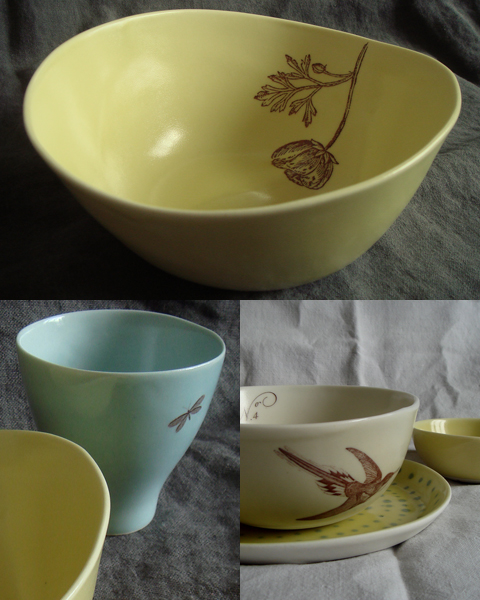
...it is to see my work photographed by my customers. I feel fortunate that my ceramics appeals to artists. Below are photographs from a lovely Franco-Russian blog, veshiwish.


Thank you, Anna, for your support and for your beautiful photography!

simply stunning


Aran, who writes and styles and photographs one of my favorite blogs, Canelle Et Vanille, is publishing a cook book in the fall of 2012. It will be gorgeous, and I cannot wait to see it. And how lucky that some of gleena pieces are used in the styling? The ivory dessert bowls, shown above, are decorated with an illustration by Cynthia Treen. Thank you, Aran, for your beautiful and inspiring work.

i love mud

How inspiring is this Australian company, from their catalogue graphics to their product? I am enamored, and have been for a very long time.


all images are from mudaustralia.com